
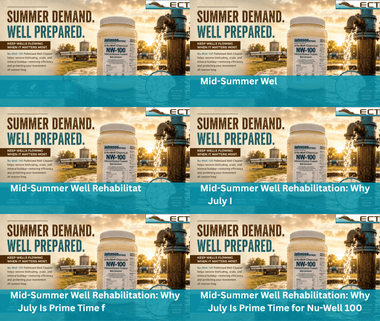
Nu-Well 100: Summer Well Rehab Guide | ECT Mfg
Posted by Walford Guillaume on Jul 6th 2026
Mid-Summer Well Rehabilitation: Why July Is Prime Time for Nu-Well 100
Picture this: it's the middle of July, the mercury is pushing 95°F, and somewhere out in the field, a municipal well that performed flawlessly all spring suddenly can't keep up with demand. The pump is working overtime, flow rates are dropping, and the phone won't stop ringing. Sound familiar?
If you work in groundwater management, agricultural irrigation, or environmental consulting, you already know that summer isn't just the busiest season for water demand — it's also the season when hidden well problems finally show themselves. The good news? There's a proven fix, and it comes in the form of small, unassuming pellets that pack a serious punch: Nu-Well 100 Pelletized Well Cleaner.
Let's dig into why July is the tipping point for well performance, what's really happening underground, and how the Nu-Well system can save your season.
Why Summer Pushes Wells to the Breaking Point
Groundwater systems don't fail overnight. In fact, most well problems build slowly and quietly, month after month, until summer's peak pumping demand finally exposes them. As water tables decline and wells are asked to produce more, small inefficiencies that went unnoticed in cooler months suddenly become full-blown emergencies.
For municipal operators, farmers relying on irrigation, and environmental consultants managing small-diameter monitoring wells (generally under 8 inches with shorter screen segments), this seasonal squeeze is nothing new. What is new — or at least, newly urgent — is the need for a fast, effective, and safe rehabilitation solution. That's exactly where Nu-Well 100 comes in.
The Culprit Beneath the Surface: Scaling and Biofouling
So, what's actually clogging your well? Throughout the spring, groundwater wells quietly accumulate a mix of mineral deposits and biological growth. Then, once summer pumping ramps up, this buildup accelerates rapidly. Here's what's typically to blame:
- Carbonate Scale – Calcium and magnesium carbonates precipitate out of the water and cement well screen slots shut, restricting flow at the source.
- Iron and Manganese Deposits – These heavy, oxidized encrustations coat gravel packs and slow water velocity to a crawl.
- Biological Growth – Slime-forming, iron-oxidizing, and sulfate-reducing bacteria create sticky biofilms that trap mineral fines, compounding the clog even further.
As a result, your pump has to work harder and draw water down further just to deliver the same output. This means more energy consumption, more heat, and — over time — a shorter operational lifespan for your equipment. In other words: what starts as a minor inefficiency in April can become a costly summer breakdown by July.
Why Nu-Well 100 Is Built for July Field Conditions
Traditional liquid hydrochloric acid treatments have long been a go-to for well rehabilitation, but they come with a serious downside: dangerous, corrosive vapors. This risk only intensifies when acid is mixed on a 90°F job site under direct summer sun.
Nu-Well 100, marketed as "Descale Right," solves this problem in an elegantly simple way — through a dry, pelletized acid compound. Here's why that matters:
- Direct Sinking Action – Because the product is made of dense pellets, it sinks rapidly through the static water column, delivering concentrated acid cleaning power exactly where it's needed most: the bottom of the well screen.
- Safer Field Handling – Pellets can be poured directly into small-diameter casings without dangerous splashing or the choking fumes associated with liquid acids, making it a safer choice for crews working in summer heat.
- Potable Water Safety – Every Nu-Well chemical is completely PFAS-free and certified to the rigorous NSF/ANSI/CAN 60 standard for use in drinking water systems, so you can treat with confidence.
In short, Nu-Well 100 was designed with real field conditions in mind — including the tough ones.
Building the Ultimate Rehabilitation Strategy: The Nu-Well System
While Nu-Well 100 performs impressively on its own, seasoned hydrogeological professionals know that modern well rehabilitation often calls for a more systematic approach. Depending on the type and severity of fouling you're dealing with, pairing Nu-Well 100 with complementary products can dramatically boost results.
1. Breaking Through Biofilm: Add Nu-Well 310 Bio Dispersant
Mineral acids alone aren't always enough to cut through dense biological slime. That's where Nu-Well 310 Bio Dispersant comes in. When combined with Nu-Well 100, it creates an aggressive, synergistic reaction that targets biofouling directly.
Specifically, Nu-Well 310 alters the treatment chemistry to hold dissolved mineral salts in suspension at pH levels up to 5.0. Without it, dissolved minerals can drop back out of solution and re-plug the screen pack as soon as local pH crosses 3.0 during flushing — undoing your hard work in real time. Additionally, if you're treating low-carbon or stainless steel screens, Nu-Well 310 includes a powerful metal inhibitor that helps prevent downhole tool corrosion.
2. Penetrating Tight Formations: Add Nu-Well 400 Dispersant Boost
For severely impacted wells or tight formations with low hydraulic conductivity, Nu-Well 400 Dispersant Boost is the answer. By reducing surface tension, it allows descaling chemistry to penetrate deeper into the gravel filter pack and surrounding formation — scrubbing away stubborn mineral deposits, pump lubricant residue, and lingering turbine oils that liquid acids alone might miss.
3. Safe Surface Disposal: Neutralizer Nu-Well 600
Of course, environmental responsibility doesn't end once the spent acid is pumped out of the casing. Proper disposal matters just as much as effective treatment. Neutralizer Nu-Well 600 is a food-grade, powdered base designed to neutralize acidic solutions at the surface without generating toxic secondary gases.
Here's a helpful field tip: once the fizzing and bubbling stop, the reaction is complete — meaning the spent acid has been safely converted into harmless water and carbon dioxide that can be discharged according to local regulations.
Your Step-by-Step July Well Rehabilitation Protocol
Ready to put this system into action? Here's the process, broken down into simple, repeatable steps:
- Calculate and Pour – Consult the Nu-Well standard dosage tables to determine exactly how many pounds you'll need based on your well's screen diameter and length. Then, pour the Nu-Well 100 pellets directly down the casing.
- Agitate and Dwell – Mechanically agitate or surge the well screen area to maximize chemical contact with fouling deposits. Allow the acid to dwell downhole for 12 to 24 hours, depending on scale severity.
- Pump and Neutralize – Evacuate the spent acid into a surface holding tank. Dissolve the appropriate amount of Nu-Well 600 Neutralizer in water and slowly combine it with the spent acid until effervescence stops and pH returns to a safe baseline.
Simple, systematic, and — most importantly — proven to work under real summer field conditions.
Don't Let July Catch You Off Guard
At the end of the day, a mid-summer out-of-water emergency doesn't have to derail your project timeline, your budget, or your operation. Whether you're managing a municipal system, running an agricultural irrigation network, or overseeing environmental monitoring wells, the message is the same: proactive maintenance now saves you from reactive emergencies later.
By stocking up on the complete NSF-certified Nu-Well chemical family — Nu-Well 100, 310, 400, and 600 — you can protect your pumps, restore full structural water flow, and lower operational costs, all while keeping your crew safe under the summer sun.
The wells that fail this July are usually the ones nobody thought to check in May. Don't let that be yours. Be sure to click here to explore our vast selection of Well Maintenance Chemicals.
Frequently Asked Questions
Why does well fouling get worse specifically in the summer?
Summer's peak pumping demand puts extra strain on wells that already have mineral scale or biofilm buildup from prior months, causing gradual inefficiencies to suddenly become noticeable, urgent problems.
Is Nu-Well 100 safe for potable water systems?
Yes. Nu-Well 100 is PFAS-free and certified to the NSF/ANSI/CAN 60 standard, making it safe for use in drinking water well systems.
How long should Nu-Well 100 dwell in the well before pumping it out?
Typically between 12 and 24 hours, depending on how severe the mineral scaling or biofouling is.
Do I need to use all three companion products together?
Not necessarily. Nu-Well 310, 400, and 600 each address specific challenges — biofilm, tight formations, and safe neutralization, respectively — so you can pair them with Nu-Well 100 based on your well's specific condition.